Wednesday, January 24, 2007

Darn Domineering Left Brains and Subversive Right Brains: The Science of Over the Edge

Many characters in the Over the Edge series are marsupial humanoids. Marsupials have the fascinating quality of lacking a corpus callosum, a structure that unifies brain halves in placentals. In Over the Edge this quality is most obviously expressed by giving each brain its own language. Characters' left brains use abstract symbols for writing and assigned sounds for verbal language while right brains use a hieroglyphic, picture based language for writing and sign language for "speaking."

Scientists have discovered that placental brains divide duties. The left brain is not only in charge of language, but also of math and logic. The right brain tends to spatial abilities, face recognition, visual imagery and music. For prosopagnosics, people who realize they're looking at a human face, but have no clue who the person is, not having this right brain ability is a problem. When a prosopagnosic doesn't recognize the person standing right in front of him, perhaps his wife or father, he also cannot link what he knows about the person to the human he sees--the beloved is a complete stranger until he or she introduces him or herself. This is the right brain showing its critical role in how well the whole person can function.

(See: http://www.brainconnection.com/topics/?main=fa/face-perception5 for more information and while there, take a face recognition test.)

In Over the Edge, the right brain operates on equal footing with the left brain. It's able to let its thoughts and ideas be known. In human beings, the right brain isn't given language and must do its work in the background, as "helper" to the dominant left brain. But in Over the Edge, the right brain can assert itself and potentially create all kinds of trouble for its domineering peer.

"Language seems to override an innate ability to understand spatial relations," says the Scientific American, January 2007 issue, page 28. Researchers compared Dutch adults and children with adults and children from a hunter-gatherer society in Namibia. When faced with five cups, one hiding a block, the Dutch could locate the hidden block when its location was described in relation to the speaker--for instance, "look to my right." The Namibians beat the Dutch under absolute geocentric conditions, using directions such as "look to the south." "When four-year old German children and great apes were tested, both preferred environment-centered processing." The testing "suggests language alters an innate preference."

It's that darned, bossy, controlling left brain. How to tone it down a bit and let the right brain speak? In Drawing on the Right Side of the Brain, by Betty Edwards, readers can practice many drills designed to put the right brain in charge--a useful skill if one desires to tap into its full potential. (Yeah, shut up you domineering left brain and let me have some of the limelight.) Her students exhibit dramatic improvement in artistic abilities when the left brain is pushed to the back and the right brain can shine. As an writer/artist who's experienced this power shift, the sensation is both a little unsettling and highly liberating.

In Over the Edge a couple of characters have some trouble with "warring brains," that is their normally happily, coexisting brains decide to feud. Talk about a really unpleasant situation. Try having a fist fight with yourself! It only works if each brain is equally in earnest and boy, when they are, it can really hurt! Note: this type of conflict has been discovered in human beings who've had their corpus callosums cut.

Surgeons may cut an epileptic's corpus callosum in an effort to provide relief from severe seizures. The corpus callosum is "a broad, thick mass of nerve connecting the cerebral hemispheres" (see: http://www.indiana.edu/~pietsch/split-brain.html ). In placental brains there's another bridge called the anterior commissure, which is also cut.

Dr. H. G. Gordon, a neurobiologist at the California Institute of Technology believes connections at the back of the brain alone are enough to integrate both human minds. Thus, a new style of this operation leaves the rear part of the corpus callosum in tact. But early operations cut the whole thing rendering some patients into Jekyll and Hyde types.


Roger Sperry neuropsychologist and Nobel Laureate, called the brain, "Two separate realms of conscious awareness; two sensing, perceiving, thinking and remembering systems."

Michael Gazzaniga, who did his graduate work with Sperry, conducted psychological tests on early "split-brain" patients. "Gazzaniga made a startling discovery. If the patient held up something like a comb or a coffee cup in his left hand, he couldn't speak its name. Transferred to the right hand -- no trouble at all."

This interpretive bent first appeared in tests of split-brain patients shown two pictures simultaneously, one to each eye, that is, one to each hemisphere but unavailable to the other eye and hemisphere. Participants then perused an assortment of additional pictures and chose the item most closely related to each of the original pictures.

"For instance, one man had a picture of a chicken claw flashed to his left hemisphere and a picture of a snow scene presented to his right hemisphere. From the ensuing selection of pictures, he correctly chose a shovel with his left hand (controlled by the right hemisphere (this would be the side without language)) and a chicken with his right hand (controlled by the left hemisphere (this would be the side with language)). When asked to explain his choices, he responded: "Oh, that's simple. The chicken claw goes with the chicken, and you need a shovel to clean out the chicken shed." Gazzaniga concluded that the left brain observed the left hand's choice of a shovel - which stemmed from the right brain's nonverbal, inaccessible knowledge - and proffered an explanation based its own fowl information," (see: http://pegasus.cc.ucf.edu/~fle/gazzaniga.html ).

Imagine how his mute right brain felt at having its selection so wrongly interpreted! "No, you overbearing, intellecutal moron, the shovel goes with the snow--the snow!"

In Over the Edge the marsupial, split-brain premise takes the issue to a spiritual level. The biblical book of James delves into this realm extensively, encouraging individuals to base their thinking on one thing and to bring their "warring brains" into compliance with that thing--the Word of God. "Anyone who listens to the Word but does not do what it says is like a man who looks at his face in a mirror and, after looking at himself, goes away and immediately forgets what he looks like. But the man who looks intently into the perfect law that gives freedom, and continues to do this, not fogetting what he has heard, but doing it--he will be blessed in what he does," James 1:23-25. "...a double-minded man, (is) unstable in all he does," James 1:8. Scientists have proved that one.

How many psychological problems do we human beings suffer because our brains are not in agreement? The right brain, denied language, might instigate depression or some other manifestation of its unhappiness or unease and the domineering left brain might never be able to understand what the heck is going on. Taking drugs to self-medicate or doctor-prescribed drugs in order to buy himself some peace, the person might only need to get in touch with his right brain to finally have it. Like the man who cannot recognize his own wife or father, or the woman who forgets her own face, the person whose left and right brains are not in agreement is a miserable soul indeed.

Image credit: http://www.brainconnection.com/topics/?main=fa/face-perception2

Hide in Plain Light: The Science of Over the Edge

Scientific American reports, "Mere months after making a technologically feasible proposal, researchers have demonstrated a rudimentary example of an invisibility cloak." The object is made of metal and wires embedded in fiberglass, it makes light act weird. David Schurig and David Smith of Duke University, along with other colleagues, designed concentric rings of the "metamaterial" that bend microwave radiation around the innermost ring, "like water flowing around a stone."

Schurig says, "We've reduced both the reflection and the shadow generated by the object, and those are two essential features of the invisibility cloaking." See Science, November 10th issue for more details. "Getting the technology up and running was easier than they anticipated, the researchers say, but don't expect Harry Potter's cloak anytime soon," page 28, Scientific American, January 2007 issue.

Minan Chameleon Battle Skin--maybe not too far off.

Update, December 2011:

"Defense contractor BAE Systems field-tested an invisibility cloak in July that can make a tank look like a car, a boulder, or even a cow. Onboard infrared cameras scan the surrounding scene, and thermal tiles covering the tank display that imagery, causing the vehicle to blend in with its environment," The Year in Science, Discover, 100 Top Stories of 2011, page 47.

This technology is the very similar to the fictional technology described in Over the Edge: The Beginning, the first volume of the series published in 2004. The series is presently being rewritten in order to reboot with a new publisher.

Wednesday, December 06, 2006

Reeser the Synesthete: The Science of Over the Edge


Vasily Kandinsky (who painted Composition VIII shown above) "imagined he could hear the tone of his paintings as he made them," says Kathryn Garfield in a Discover, December 2006 issue (page 19). In book two of the Over the Edge series, Reeser has a vision in which music becomes "chocolate in his ears and delicious, deep red roses in his mouth."

"This confounding perception--called synesthesia--was thought to affect at most about 4 percent of the population," continues Garfield in her article. "...but a University College London professor, Jamie Ward, has uncovered the best evidence yet that we may all have a bit of synesthesia."

Mr. Ward asked a random 200 visitors at a museum in London to view two musical animations. One animation was designed by synesthetes and the other by non-synesthetes. The volunteers preferred the synesthete-designed animation as a better match, animation to music, than the non-synesthete designed piece. The study indicates that though they didn't realize it, participants' senses were synchronized better than anyone imagined.

Wonder if unconscious synesthetes can learn to tap their unrecognized abilities? By the way, spinach really does taste green.

Friday, May 19, 2006

Space Trash & Scavenger Robos: The Science of Over the Edge

The June 2006 issue of Scientific American posted an article on page 26 titled: Data Points: Girdled by Garbage.

"Discarded rockets, exploded satellites, paint flecks and even human waste contribute to the earth's orbital litter." Our space trash is hazardous to space travelers: "Even if humans stopped launching satellites now, debris will increase after 2055" because bits broken from larger pieces will increase the total quantity and will "exceed the rate of destruction by reentry burn-up."


Fact Sheet:

"Percentage of orbital objects that are debris: 93

Number of fragments at least 10 centimeters wide: 9,000

Combined mass, in kilograms: 5 million

Number of known orbital collisions, 1991-2005: 3

Number of collisions expected in the next 200 years: 18

Number of collisions expected to be catastrophic: 11"

Stated source for information: U.S. Strategic Command Science, January 20, 2006.

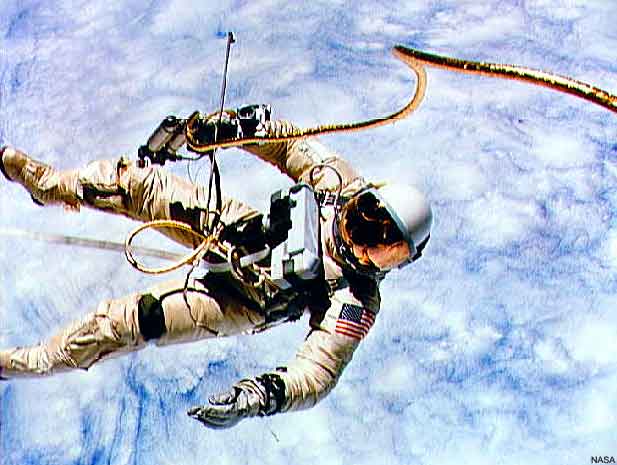
Sounds like NASA needs some scavenger robos.


Cleaning up space junk

NASA photo: Ed White Space Walk

Monday, May 01, 2006

Short Story: Ystem Aver Goes Over the Edge

Early afternoon sun beat into the clearing, a man-made hole in the verdant jungle far from any civilized outpost. Humidity pressed in, invisible rays of light boiled the air.

Captain Ystem Aver, a full-blooded Celian, stood opposite his step-father who gazed at him across an early fire. His maroon tinted skin was much lighter than that of men standing nearest him. Too long in space, he thought wondering if the ruling class’s preference for lighter skin was still the measure of beauty. Not that it’ll do ye any good.

Ystem’s eyeliner tattooed lids hardly fluttered while the sea blue orbs they shielded remained firm and calm. He wore a white silk shirt with full sleeves caught tight around his wrists. A silver ring adorned one finger. A black leather belt with a “Celtic” style belt buckle in silver held up wide leg pants stuffed into calf high, black leather boots. His Kaildescope perched on his belt.

Through his Kaildescope he knew everything happening aboard his ship. He knew the state of the engine plants, the health of his gardens and if the assigned men were poised in readiness as he’d commanded, a laser target set on the head of the man now glaring balefully at him.

Walusi, his mother, crouched on the ground near her husband, her eyes fixed on her son.

Konobana folded his arms across his chest, his own teal green silk shirt rustling in the deadly silence. For a long moment, only a bird spoke, the jungle oddly quiet, the insects hardly murmuring, a gentle undertow of concern. At last, Konobana sneered.“What say ye, son? I purchased ye and yer mother, keeping ye both from a fate worse than death. I bought a fine education fer ye in the Federated Planets’ space merchant schools--will ye be honoring yer debt or snub yer loving Father once again.” Simultaneously he signed, “(Look at ye, soaking up the fine ideas they be teachin’ ye? Eh? I kin see their idleness in the set o’ yer jaw. Ye any wiser fer yer stay ‘mongst the soft, city dwelling folk?)”

Ystem considered the distance to his gun. “Aye, ye bought me education and me heart be grateful even into the Great Beyond, but I no be doing any thing ye bid-me knowing yer black heart all too well. There be many fine chores, legal ones ye kin be sending me to bear fer ye, but I will no break a law, be it man-made or divine.” He ignored Knonbana’s signed insults; his hands merely emphasizing his spoken words.

“Aye, so say ye,” Konobana snarled as he grabbed Walusi’s hair, yanking her head back to expose her neck. His knife, glinting in the sun, pressed at her throat. He nodded to the men standing behind Ystem. One moved away noiselessly as all jungle tribes’ people were trained to do.

Ystem strained his ears to discern the man’s direction. His space jet stood about fifteen yards away, two of his crew an honor guard, but hardly equal to the hundred or so men Konobana had brought with him to the meeting.

Konobana said, his voice grating, “What say ye now? Eh?" Simultaneously he signed, the thumb holding the knife, the fingers moving, creating an odd slurring sign language. "(Me thinks fer the life o’ yer beloved Mother, ye do most anything, eh?)” He chanced a quick glance at one of his men as he chortled, turning his face back to Ystem. “Ye do honor yer mother, do ye nay?”

The man, a middle-aged Celian with no tattooed eyeliner gracing his lids, nodded and smiled. He was shirtless, wearing a leather vest, silk leggings and ankle high moccasins. His aqua eyes fixed on Ystem, their cold, reptilian glimmer unmistakable.

Ystem moved his fingers another tiny fraction closer to his gun. Ah, so that be his Most Trusted. With his other hand he signed, “(I say, ye be a fool.) Ye no be telling me the task, I no be making promises.”

Rustling in the brush behind let him know a group of about fifteen approached. He forced himself to choke back the sigh of relief pressing at his lips. Me men’r safe. The group skirted around the fire to stand near his mother, Walusi, whose eyes still stared at her son, her knees in the loose, black dirt, an insect boldly crawling up her leg.

Fourteen of the group were chained together, their clothes torn and dirty, their hair matted, their faces downcast. Ystem waited, his eyes flicking between Konobana and the bedraggled prisoners.

Konobana threw his head in the direction of the bound men and women. “They be needing transporting to a waiting ship presently in orbit just above us.” Simultaneously as he spoke, Konobana signed, “(I be knowing ye kin carry the lot o’ them in yer space jet. Ye kin fulfill your filial duty in this one deed fer me and ye then be shut o’ me for me lifetime.)”

Ystem’s mouth edged to a smirk. “Do they? An’ why they be needing transported? (One foul deed merits another and me beholding to yer knife will see no end until ye or I be gathered to our fathers.)” No expression entered his eyes as he spoke and signed, but he’d already assessed the readiness of the men immediately surrounding Konobana. They were untrained and already restless, their ears only half-listening and their senses fogged as blood-lust rose in their ears. Ystem had seen the look many times around similar council fires.

Konobana’s knife brought a droplet of blood to Walusi’s neck. It dribbled slowly a few inches before stopping, the drop and its trail drying on her deeply tanned, maroon tinted skin. She made no sound though her eyes closed for a moment, the black tattooed eyeliner on her lids pronounced clearly on her blanching skin, her aubergine lips whitening with pressure.

Konobana hissed. “They be me property and I be wanting ‘em transported. Are ye daft? (I promise ye, son, this be the single deed I require.)”

Ystem counted ten slow breaths and straightened his posture, loosening his shoulders and relaxing his muscles. “I no be a slave runner. (An’ ye be a liar.)”

Konobana’s thrust was swift and his rage unmistakable. “(No man calls me a liar and lives to tell.)”

Ystem felt the blade finger his hair and heard its whispers of death as it passed, but he didn’t move, not even his eyelids. The men behind him fell to the ground, their bodies making the characteristic thud of lungs air-filled as they dropped to avoid the weapon. He heard the knife crashing harmlessly into the brush a few yards behind him. A disturbed bird skittered into the sky.

Konobana laughed and yanked Walusi’s hair one final time before tossing her head carelessly toward the fire. “I knew ye no be doin’ this task fer me. Ye be too wedded to the Law o’ your Father," Konobana paused to spit, "An' The Way of The Eternal.” His signing took on a particularly derisive tone. “(Devotion to the Ten Words were always yer failing. Fer Him ye'd kill yer own Mother.) Fetch me a drink, woman, and tend to yer son. His thirst be mighty ‘bout now I expect.”

Walusi smoothed her hair and adjusted the bodice of her dusky purple dress. She got to her feet, walking slowly toward one of the pack animals standing patiently ever since Ystem had been brought to this clearing. The creatures happily chewed feed in sacks tied round their muzzles.

One day I be buying ye safe from ‘im, Ystem promised her, the thought unspoken, but intensely felt. His mother glanced at him and smiled. His head inclined toward her, a tiny movement hardly worth note.

“Ah, yea, ye be a fool to be clinging to that religion,” Konobana said, now crouching near the fire. He picked up a stick and threw it into the flame. “(Take ‘em back to the holding pen,)” he signed to the guard.

Guard nodded and led the bound group away, their weariness heavy in the air.

Mentally, through the Kaildescope, Ystem commanded his men to stand down for the moment. If Konobana had taken his mother’s life, the lives of every person in the immediate vicinity, save his own men, would have been forfeit. His own life most assuredly, but not until he’d invited however many The Eternal gave him into the Great Beyond with either his pistol or the knife secured in his boot. Not a few answering to the laser that would have first removed Konobana from this life placing him into the next to face his Maker.

Ystem ventured a quick glance around the clearing, taking a rapid count of heads. “Now ye satisfied yerself o’ me nerve, what task have ye fer me?”

Konobana laughed. One of his men sprinted to his side and whispered. Konobana’s eyes narrowed to slits. “So, ye had a laser target trained on me head, did ye?” Signing rapidly with his hands, he added, “(Ye plottin’ to kill me an’ everythin’ else within range?)”

Ystem folded his arms across his chest. “Aye, I did. An’ if ye be killin’ me mother, ye woulda felt its burn.” He freed one hand to sign, “(Nay, me men survive.)”

Konobana swung his opened palm signifying the whole camp. “An’ in the split second it take yer men to fry me brains—happen chance I move? Eh? Then ye be killing yer own mother?” He didn’t answer Ystem’s signed remark.

“Did ye no hear me? I be saying, in the case ye kill me mother--then ye and all yers be dead men.” Ystem snarled, finally permitting a show of emotion.

Konobana laughed. “An’ ye yerself too…”

Ystem answered. “Aye, if ye be killing me mother, it’s a given. But nay before I take a few of yers with me into the Great Beyond. (An’ man, I take the lot o’ ye. Afterward we all be standin’ in The Presence and then ye be takin’ note.)”

“Dinna yer fine Ten Words be commanding, “Ye shall no murder?” Konobana asked. “(Yer blood lust be no fittin’ measure o’ a fine religious man.)”

“Aye, it do.” Ystem watched a change suddenly occurring in the camp. Three tents were rapidly going up, their jungle camouflage failing to disguise the expensive fabrics. The men placed luxury camp chairs near charcoal braziers soon burning fragrant incense to ward off night insects. “(Me blood lust, eh? Me be wishin’ ye face to face with yer Maker--in this life preferably.)”

“But if ye be killing me and mine, then ye be committing murder,” Konobana sneered. “(I have no maker, ‘cept the slime o’ this place.)”

“Nay, self-defense be no murder.” Ystem answered, suddenly tired of his step-father’s taunts. “What say ye? Ye be baitin’ me, hopin’ to get a rise or ye be tellin’ me what ye be wantin’? (I no be callin’ ye slime, ye done it yerself.)”

Konobana laughed. “I be showin’ ye I no be vindictive. I kin forgive ye yer slights and to further prove me actual good intentions, I make the slaves a gift to ye. (All life come from the slime, includin’ yer self-righteous self.)”

Ystem’s blood froze. For the first time he was unsure of what to say next. Using his Kaildescope he contacted the ship in the “Morse Code” version of the signed portion of the ancient dual Celian tribal tongue Ystem used. Through the Kaildescope he communicated, “(Are me men by the jet remaining in this world?)”

His First Mate replied, the clicking morse code sounding in his brain. “(Aye, Cap'ain, they be yet alive and yer step-father’s men be bringing ‘em food.)”

Ystem snapped a quick reply. “(Be tellin’ em, no be eatin’ anything my step-father’s men be givin’ em. The food stored in the jet be more fittin’ fare if they wish to continue in this life.)”

First Mate responded. “(Aye, Cap'an.)”

Ystem continued, mentally clicking out the code. “(An’ be tellin’ em, one sleep now and the other keep watch.)”

“(Aye, Cap'an, I be tellin’ ‘em even now.)”

“(Good.)” Ystem’s attention had been divided. He was surprised to see a new man enter the camp. Ah, ye fool. Yer first mistake, he reprimanded himself.

A foppish, lanky limbed fellow wearing fine designer clothes walked to Konobana’s side.

Ystem bowed. “Afore I kin be acceptin’ yer “gift” I must needs pray.”

Konobana’s lips curled in disdain. “Pray?”

“Aye,” Ystem said wearily. “Listen man, I no be quitting me faith fer no amount o’ yer jeering--what your way got you has no appeal fer me.”

Konobana laughed. “Yer legendary calm be shot to hell.”

Ystem’s squinted and he fought down the blush that threatened to swamp his face. Yer second mistake. He be gettin’ a rise out o’ ye an’ ye be a fool. Deliberately he turned his back on his step-father, his skin crawling with unease and walked to his jet.

One of his men had slung a hammock under the jet and was already dozing. The other crouched atop its fuselage, his laser gun charged and his finger ready on the trigger.

Ystem smiled his pleasure. “Aye, ye be fine men, aye and aye agin. Ye be earning extra half-time me thinks.”

A faint smile crept up the lips of the supposedly dozing man. His companion chanced a quick glance at his Captain, a grin in reply.

“As ye were,” Ystem said softly and crouched under the jet. He prayed silently. What say ye now, LORD? Aught I be taking the captives or nay?

Sunlight was quickly fading and Ystem felt pleased to note his men had their night vision goggles clipped to their belts, ready. He glanced around the small clearing his jet had created while landing. The jungle noises, seeming distant only minutes earlier, were closing in, but unlike a Kabelian man raised in the desert or an Ephonian man raised in the tundra, close places did not disturb him, on the contrary, wide open places had that effect. Ystem was jungle born and well acquainted with each bird that spoke, each insect that ranted and each mammal grunting in his immediate vicinity. From their noises he knew none of Konobana’s men had changed their earlier positions and the season had thus far been good for the beasts.

Ystem waited, listening, with both his physical ears and his spiritual ears. Finally, he understood. Take the captives, but know ye this, they be meant to trap ye. He thought in reply, Aye, I be takin’ ‘em since Ye be commandin’ it. A new thought came to him. Konobana be settin’ one more trap fer ye this very evenin’. Well met, ye no take ‘is bait, but be wary o’ flattery, especially from this son o’ his ‘e be askin’ ye to take. Yea, ye take ‘im as yer step-father be askin’ but be wary. He means ‘im fer yer ill, but I be meanin’ it fer yer good. Ystem nodded and thought, a tinge of exhaustion infringing upon his peace. I be in fer another round o’ trainin’. And he knew the answer was “Aye. This life is all trainin'.”

Carefully, Ystem moved from under the jet and looked up at the man perched above. “Listen,” he said, pitching his voice to fall dead outside a ten foot circle. “If’n I no be comin’ back by mornin’ ye and Arcan be leavin’ me carcass here.”

Arcan broke off his careful scanning of his surroundings and peered down at his Captain. “Cap'an?”

Ystem signed, his face earnest. “(I be coming back by morn. Be alert. This be no fine, entertainment.)”

Arcan saluted. “(Aye, Cap'an, I long since be knowin’ this be no fine entertainment. It have no resemblance to any fine entertainment I ever be enjoyin’!)”

Ystem chuckled and crept quietly back to the camp.

Konobana still crouched by the fire and the lanky fop sprawled in one of the fine camp chairs as Ystem entered the grounds. Night was falling quickly in the already twilit jungle. The smell of cooking meat drifted toward him, its delicious odor tempting him.

Konobana got to his feet and gestured toward the lanky youth. “This be me son by me first wife, Donicara. (Ye never hear o’ her, I expect, as she failed me long before I met ye.)”

Ystem froze. His step-father’s tone was far too solicitous. He bowed to the seated man and signed the proper greeting. The young man didn’t rise as politeness required, but languidly returned the greeting.

Frowning, Konobana made the sign “rise up” to his son.

The lanky young man stood, returning Ystem's bow with just enough humility to avoid insult.

“Me step-son, Ystem Aver, be knowing me son, Moon Ealay.” Konobana spoke awkwardly, his eyes averted to the ground as he signed the introductions.

“Moon,” Ystem said, bowing his head a fraction.

“Ystem,” Moon replied, keeping his head upright. His eyes seemed to dance with wicked anticipation.

“Be sitting.” Konobana commanded. “(We shall feast tonight.)” He led the way.

One of his men raised the tent flap and a golden-lit scene was revealed complete with elegantly set table and tall candelabra. He signaled the men to their seats. Konobana’s Most Trusted entered, lifting a corner flap to join the men at the table.

He be wanting me for a task, he no be killin’ me tonight, Ystem thought as he rubbed his hands together. “I smelt the delicious repast as I walked back to yer camp.”

“Aye, me cook be the greatest.” Konobana replied with pleasure. “(Fer the moment, you and I forget our differences and enjoy, eh?)”

Ystem stared at Konobana, then replied. “(Very well, fer the moment.)”

Konobana laughed. Others of his men appeared bearing steaming plates of fresh meat, cold fruits and vegetables and the group set to.

The meal completed and the sherbet before them, Konobana broke the truce. “Ystem I be asking ye to take Moon as yer apprentice.”

Ystem’s spoon stopped an inch above his bowl.

Konobana’s eyes seemed to hold no guile. “Aye, that’s what I be askin’. (And me request no be illegal…ye kinna deny me.)”

“Ye be giftin’ me the slaves and ye be askin’ me to train yer son…” Ystem repeated.

“Aye. Yer understandin’ me correctly.” Konobana smiled broadly.

“I reckon ye be meanin’ me harm by yer machinations, but I be doin’ as ye bid when ye be lettin’ me Mother free.” Ystem spoke then wiped his mouth with his napkin. "(Be letting me Mother free.)"

Konobana’s smile faded. “Ye be a fool if’n yer thinkin’ I give up me hostage and give ye one!” He snorted and turned to the side, pushing his chair away from the table in one motion. "(She be me wife and yer insults tear me heart.)"

Ystem’s eyes narrowed. “I be no makin’ secrets--me Mother free be my goal. (Wife or no, she not be a free woman.)”

“I ken ye be wantin’ yer Mother free, I no be an idiot.” Konobana rested a forearm on the table and the other on the back of his chair. “(An’ this be the way ye treat yer long suffering step-father.)” He shook his head in irritation. “(I ask so little o’ ye.)”

Ystem burst into laughter. “(Aye, ye ask little o’ me, but when ye do ye ask big.) Very well then, leave it lie. I take yer son as apprentice, but under certain conditions.”

Konobana’s head rotated in Ystem’s direction. “And what be they?”

“First,” Ystem began, pointing with his spoon. “He obey me commands to the letter else I ship ‘im back to ye faster’n ‘e kin spit.”

Konobana’s head continued its rotation to stare at Moon. “What say ye? Kin ye keep this condition? (I be agreein’ to it if it were me, it no be unreasonable.)”

Moon’s eyes narrowed. “Aye, I agree.”

“Second,” Ystem continued. “He do the work assigned ‘im with no complaint. (I warn ye, I be a hard master. Me men are the most fit, most able-bodied space men ye’ll find in the Federated Planets an’ I’ll brook nothing less.)”

Konobana adjusted his position to face the table once again and glanced at Moon. “He no be asking unreasonably o’ ye.”

Moon frowned. “Aye, I agree to do the work with no complaint.”

Ystem nodded. “Fer any infraction I kin send ye back to yer father, no explanations offered. In me case I will honor my promise and train ye as me apprentice, I no be askin’ more o’ ye than I ask o’ meself or me men.” He finished the sherbet quickly. “Third, he git no pay until I say ‘e earned it.” Ystem placed one palm on his thigh and turned his eyes to Moon.

Moon’s face was now carefully blank. “Aye, I agree to your terms.”

“Fourth,” Ystem said, “Ye kin take no slave nor servant to wait on ye, ye’ll wait on yerself as I and all me men do.”

Moon’s laugh was cold. “Fine, I’ll take no servants.”

Ystem stared hard. “Finally, I no trust ye. (Be knowin’ up front, ye no be trusted. Ye’ll be watched.)”

Moon folded his arms over his chest. “I’d be ashamed of you if you did trust me. (I expected to be watched.)” The challenge in his eyes was unmistakable.

When Ystem turned his attention to Konobana he didn’t like the wily look that met his gaze.

“So, it be settled then. (An’ ye soon be seein’ the end o’ yer filial duty to me.)” Kononbana laughed and rose to his feet. The three men shook on the bargain with the typical Celian handshake, slapping opened palms and then clasping firmly.

*****

Moon’s servant followed a bell robo bearing his two large trunks to the space jet where Ystem’s men stood, their laser pistols charged and ready. The group of fourteen slaves fidgeted on the sidelines, their chains rattling in the pre-dawn damp. Konobana, Moon and Ystem approached from the camp, their foot-falls hardly audible even to discerning ears.

“Well then, take yer leave o’ me and I wish ye success in yer ventures.” Konobana said expansively, moving his hands in a similarly kind sentiment.

Moon grimaced.

Ystem bowed, but did not reply. To his men he commanded, “Load the slaves first.”

Bloon, gestured to the frightened, shivering group as he lowered the ramp. “Go on and I’ll be meetin’ ye inside.”

The fourteen bedraggled slaves clanged up the ramp with Bloon behind them. Ystem gestured toward the jet, inviting Moon to make his entrance, then followed him with Arcan bringing up the rear, his laser pistol ready. Bloon placed the slaves in a secure cabin, settling outside their door on a jump seat while Moon joined Arcan in the main passenger cabin. Ystem was about to close the ramp when a girl rushed out of the brush past Konobana and his retinue.

“Captain Aver,” the girl called. She bowed and waited at the foot of the ramp.

Ystem paused, then came down to meet her. “What is it?”

“(Your mother sent me with a note.)” The girl glanced nervously at Konobana who folded his arms across his chest, frowning.

Ystem took the note and opened it. “My son, the LORD has commanded me to release you from your vow to obtain my liberty. (Go and be free to choose as He would want without concern for me. He will care for me and one day I shall be free, even if that day is the day when I join my fathers in the Great Beyond.)” The note was signed, “All my love, Mother.” Ystem stared at the girl a moment, then bowed. “Thank ye.” He signed a proper farewell and returned to the top of the ramp. When he looked back, the girl was already gone, disappeared into the surrounding bush.

*****
It was a short jump from the planet surface to the Hardship, a half-size deep space vessel one mile wide and eleven hundred fifty feet tall; a squashed sphere of diamond, gold, titanium and carbon steel. The space jet docking bay’s lens-like egress opened at his approach and the jet landed neatly in the center of the white enameled maw. As soon as the gate closed, men leaped from the protection of air-filled booths to tie down the jet and secure its perimeter.

The slaves were led away to a holding pen where criminals were kept when the Hardship hauled such charges. Though Ystem’s sympathies lay with the slaves they were down trodden, perhaps uncertain of their identities and viability as worthy persons and likely primed to believe him a murderer. Better to be safe, he thought, watching his men lead them away.

“Ho, so this is the famous Hardship,” Moon said happily. “(Oh the things I’ve heard...you haul the most dangerous cargoes they say...the stuff others won’t touch.)”

“Yes, this be she.” Ystem answered cautiously. “(That’s me specialty an’ it’s a specialty requirin’ all a man’s wits, a goodly lot o’ nerve and every scrap of self-discipline a man kin train ‘imself to acquire and then more.)” He studied Moon through his brows while the younger man gazed in wonder at the vast space jet docking bay. Mechanic robos were already climbing over the jet doing routine maintenance before moving the it to its more permanent dock.

Moon’s eyes were unreadable as he spoke. “They say you are the greatest Celian Captain alive, Captain Ystem Aver.”

Ystem’s face showed his skepticism and Moon prepared to add a signed comment, but was interrupted.

“The prisoners are secured,” one of the men spoke as he hurried up to Ystem.

“Good. (I want ye listenin’ to ‘em day an’ night.)” he said. The man nodded and hurried back the way he’d come. “Arcan, show Moon to his quarters.” Ystem ordered. “Moon, when ye’ve looked ‘em over, meet me in the cockpit.”

Moon nodded, looking slightly puzzled.

“Arcan be showin’ ye how.” Ystem said and strode away. He busied himself in the control booth as Arcan and Moon passed through on their way down the corridor to the tube, the hollow energy elevator that ran from top to bottom of every modern deep space vessel using the gravitational drive invented by the great Kabelian scientist, Candan Rubeek.

Bloon stopped next to his Captain, openly watching Arcan lead Moon across the steel floor and down the hall. “What possessed ye to take ‘im on?”

“Konobana, me step-father, promised me I’d be shut o’ ‘im if I trained Moon for apprentice.” Ystem answered. “(An’ we’ll be needing to watch him like the wolf he be.)”

Bloon nodded. “An’ the human cargo we acquired along with ‘im, what ye make o’ that lot? (Ye be tradin’ slaves now, Cap’an?)”

Ystem answered. “What I make o’ ‘em, I kinna tell ye till I speak with ‘em, but first they be needin’ to learn a bit o’ trust and me thinks they lack it. (I no be tradin’ slaves. When I kin, I be takin’ ‘em home.)”

Bloon nodded again, keeping further thoughts to himself.
*****

“Cap’an, they’re Ansi tribesmen--the whole lot o’ ‘em.” Arcan muttered as he sat at the Captain’s table in the dining area in his quarters.

The far wall, opened to the jungle, let a monkeen's scream into the room while birds cawed and dusk fell. The Hardship’s garden level boasted three mini eco-systems ringing the command crew quarters hugging the tube, its brushed steel exterior visible above their rooftops and pressing through the ceiling, an apparent “sky.” A third of the available garden acreage was devoted to jungle with 300-foot trees in the tallest portion nearest the tube. The central third was devoted to semi-arid transition land leading up to the final third, a Lieban styled forest climbing a “mountain” up to the space worthy wall abutting the rear of the jungle. This mountain received snow in the winter and supported a small herd of deer-like creatures. Digital screens lined the ceiling and garden hull walls giving the illusion of sky, distant vistas and the real sensation of sunlight or moonshine.

“Ansi?” Ystem asked, his mouth full. A breeze rustled the sheers at the floor to ceiling opening—its folding windows pushed aside so that the exterior was actually merely an extension of Ystem’s living space.

“Aye. (They’re all blood price sold.)” Arcan’s elbow rested on the solid, polished table.

Ystem threw his napkin. “What? (Blood price sold?!)”

“Aye,” Arcan answered calmly. “(That’s what they be telling H’Seth. ‘E’s the one I sent in there preten’in ‘e be also a slave.)”

Ystem waved his hand. “(I be no confused--I well ken yer plot.) I’m askin ye: be ye certain--blood price sold?”

“Aye, I be certain. (They be adamant sir. Blood price sold and feared o’ going ‘ome. Upon showin’ their faces to their people, they be dead men and women--the lot o’ ‘em.)”

Ystem’s face purpled and he pushed his chair away from the table, his appetite gone. “This be a foul stink. (A fine squirm in the stew, aye and aye again.)”

“Aye, an’ ye be set on sendin’ ‘em ‘ome and it be sendin’ ‘em to their deaths.” Arcan said reaching for a fruit Ystem had left untouched.

The Captain ignored him as he helped himself to the food. “Mayhap the Old Wolf be seein’ this a chance to gift his son a ship, eh?”

“Aye, likely. He bein’ the closest kin and all that.” Arcan mumbled as he peeled.

Ystem dropped his head back and stared at the ceiling where wood beams divided the glittering white stucco into trays. “Or, ‘e laugh as ‘e make me a de facto slave owner.”

“Aye, it look that a’way.” Arcan stuffed another bite into his mouth.

“That be good fruit or no?” Ystem asked suddenly, his attention fixed on Arcan’s juice smeared mouth.

“Well, aye it be! (And so it is!)” Arcan laughed.

Ystem chuckled bitterly. “ ‘E promised me I’d be shut o’ ‘im, but I knew ‘e were laying a trap fer me and ‘e were--aye ‘e were. (Thank you and ye be leaving the rest o’ those victuals for me!)”

Arcan got to his feet, grabbing one more piece of fruit. “(Aye Cap’an, I be seeing ye in the mornin’.)”

Ystem listened to Arcan's boots as he walked across the wood floor to the travertine tiled entry and out into the tube, the door clicking shut behind him.

“So what say Ye now,” Ystem murmured. “(What say Ye now, LORD?)”

The intimate Voice sounded in his head; The Presence filled the room like a cloud. Ye be freein’ ‘em that’s what ye set out to do. I be with ye and ye shall not fail nor shall yer head go down to the grave.

A cold sweat broke out on Ystem’s forehead. “Aye, that’s what I set out to do. (If Ye be with me, then I go.)” He got to his feet and strolled to the opened windows pulling first one side shut then the other as rain began to fall.

*****

After a full night’s sleep and a hearty breakfast of all his favorites, Ystem rode the energy elevator up to the cockpit and fell into his command chair. The familiar morning crew worked at their stations, little to occupy their attention as they’d just unloaded a cargo before meeting Konobana and had no new cargo, save the slaves, to manage or destination set. Ystem spoke. “We’re headin’ back down to the planet to the Ansi tribal grounds. (I be needin’ a solution for me course to the Ansi tribal grounds.)”

“Aye, Captain,” his Lieban Navigator replied and instantly set to at his computer. Scat already circulated through the ship and everyone knew what was afoot. Before Ystem could leave with the disc, the plotted course saved on it, Moon arrived in the cockpit.

“Ah, Moon, I see ye come to begin learnin’ yer trade.” Ystem said casually.

“Nay, I didn’t come to learn anything save your fate.” Moon’s face was hard and smirking.

“Ah, me fate. (What do ye think me fate?)” Ystem asked.

“(You’re a dead man. All for your stupid religion and your faith in the outmoded, stupid Ten Words.)” Moon added particularly sarcastic emphasis to “Ten Words” signifying “useless and daft.”

“I ken the plot ye brewed with yer father and I ken ye have no clue the significance o’ either the Ten Words or their Author. (Ye be a fool if ye think I rest me fate on the Ten Words. Me life be in the Hands of The Eternal and He be able to keep it!)” Ystem spoke and signed with more conviction than he felt.

Moon laughed. “Is that so. Well, then, we shall see, won’t we? (And I am no fool. The Eternal never did anything for me and He won’t be doing anything for you either.)”

Ystem glanced at the stars and the curve of the planet through the domed, diamond window cupped protectively over the cockpit. “We shall see. But I tell ye, whether He save me or slay me, I will worship Him. (Mayhap, ye never asked Him for anything He could give ye and mayhap, if ye did, ye didna ask in faith.)”

Moon barked a sardonic laugh. “Aye, we’ll see and I’ll be laughing as I take charge of this ship--make no mistake, it’s a fine one, just as my father promised! (I don’t want anything He’d be willing to give me since He’s not interested in anything that interests me and the claim of “lack of faith” is the everyman excuse for His failure.)”

Ystem nodded, but didn’t reply, choosing instead to enjoy the view. “It’s a beautiful sight, is it no?”

“Aye, and a fitting one for a man soon to be dead.” Moon replied.

Ystem’s men bristled in their seats, but an imperceptible gesture from their Captain kept them pinned and silent. “The Ansi tribes’ home is but fifty miles from yer father’s camp. And ye ken where we’re headin’, do ye no?”

Moon sneered. “Aye, I know. (You’re going to do exactly what my father predicted you would do--give your life for that trash you took, as he said you would.)”

Ystem’s expression was unreadable. “Ah, ye think yer father a wise man, do ye no?”

Moon didn’t hesitate. “Aye, I do.”

Ystem moved past him to the tube entrance. “Well, then, ye’ll be glad to come along an’ see me fate, will ye no?”

Moon smiled, ignoring Ystem’s men whose teeth were bared, but remained rooted in their seats as their Captain had commanded. “Yea, I’d love to go. (Let’s gather everyone up.)”

*****

Ystem, Moon, Arcan and Bloon landed in a clearing not far from the Ansi Chief’s home with the fourteen slaves, still bound, but now clean and fed, in tow.

The Chief was a middle-aged man with his black, purple-tinted hair knit into multiple braids wound into a cockscomb-like configuration upon the top of his head. He strutted out of his house and paused next to the council fire opposite the place where the men stood.

“What brings you men here with the blood price slaves, eh?” Chief asked, not bothering with pleasantries or preambles.

“I come to redeem these slaves,” Ystem said, his legs planted firmly and his arms folded in resolve over his chest.

“What? Are you mad? You’re an outsider! (You don’t have to do this!)” Chief shouted, flummoxed.

“Aye, I ken I’m an outsider. I’m a God-Fearer and as such I ken the meanin’ o’ blood price--I make me sacrifices as needed as do every other decent God-Fearin’ man. I ken the blood price--yea and yea ag’in.” Ystem’s voice was measured and quiet, though clear to everyone in the vicinity.

The Chief’s wife wandered out of the house bearing a tray of refreshments. “You men please be seated.” She shot her husband a look for his inhospitable attitude.

The slaves sat on the ground while the rest took seats on stumps set in a circle around the council fire pit. When all the guests had been served Chief spoke again. “So, you’re here to redeem these murderers?”

Ystem replied, the rough, hand-made cup empty in his hand. “Aye, ye heard me correct. (It is the command of The Eternal and my fate is in His Hands.)”

“Ma’am it be a fine beverage ye be servin’,” Arcan spoke out in the lull. “(Thank ye.)”

The woman nodded and disappeared into the house. Soon several other Ansi tribe members filtered out of the undergrowth to sit in positions near their Chief.

“These men are the tribal council. We will now decide your case.” Chief began speaking to the group in their native tongue--a language Ystem did not understand. The slaves murmured, shifting uneasily behind the Captain and his men.

At last, one of the slaves leapt to his feet. “Captain Aver, you needn’t redeem me--I’ll accept my fate. (It’s better to be a dead man than a slave.)”

Two others joined him. “We stand with this man--he’s right--Captain Aver shouldn’t redeem us--he’s an outsider and has no knowledge of what we’ve done or what we deserve.”

Chief held up his hands. “He understands the blood price. I know enough of the worship of The Eternal to tell you he may understand it better than you!” He signed, answering the first speaker, “(You could have made that choice when you were condemned, but you didn’t!)”

One of the slave women burst into tears.

An overweight councilman spoke up. “Outsider, what possesses you to intervene on behalf of these murderers?”

Ystem blushed, showing emotion for the first time. “I tell ye men, I tell ye true, I was gifted these slaves by a man...”

Chief interrupted. “Would that be Konobana Ealay?”

Ystem answered. “Aye, that be the man.”

The Chief rested one elbow on his knee, his hand hanging loose, the other hand on his thigh. “We know this man. After these murderers left our camp in the company of the slave trader we heard he’d given them to Konobana to pay off a debt. (How do you know Konobana?)”

Ystem’s eyes dropped a fraction. “(Konobana is my stepfather by stint o’ purchasin’ me mother an’ me from slavers when I were but a teen.)”

Another council member spoke up. “So, you’re saying Konobana Ealay gifted you these slaves...and you’re here to pay the blood price...”

Ystem nodded his head. “Aye, that be what I’m sayin’.”

Murmuring amongst themselves, the council gestured animatedly, often glancing at Ystem and the slaves. At times their voices grew loud, though mostly they were low, almost inaudible. The sun made its course, first climbing the dome of the sky, then languidly sliding down the other side.

At long last Chief made his decision. “You’re not the man to redeem these murderers. You were deceived and trapped into this action. The man who placed you in this trap is the man who should redeem them since that is clearly the action he intended for you to take, him knowing your character and your resolve. (Konobana is the man who rightfully should finish this. You’re free to go. And when we’re through with him, your mother and all the rest he owns will be freed as well. This we will do to honor a man whose honor is greater than even our own and the likes of which we’ve never seen. And not for our kinsmen who dishonored their tribe, but who shall live anyway because of you and your willingness to sacrifice your own head for their sorry ones.)”

The whole council stood to their feet as one person and bowed low in deepest respect.

The overweight councilman spoke up once again. “And Captain Aver, when we’re home once again, you must come and tell us more about this God, The Eternal. (I am curious about a God who could inspire such bravery and honor.)”

Ystem smiled. “Aye, it shall be an honor to share Him with ye!” He also got to his feet and bowed.

Friday, October 07, 2005

Radio Tags: The Science of Over the Edge

This article is quoted from Wired News "Radio ID Tags: Beyond Bar Codes": http://www.wired.com/news/technology/0,1282,52343,00.html

"An emerging technology could usurp the ubiquitous bar code's quarter-century of quiet domination.

"Radio frequency identification (RFID) tags, which consist of silicon chips and an antenna that can transmit data to a wireless receiver, could one day be used to track everything from soda cans to cereal boxes.

"Unlike bar codes, which need to be scanned manually and read individually (you have to actually see a bar code in order to read it), radio ID tags do not require line-of-sight for reading. Within the field of a wireless reading device, it is possible to automatically read hundreds of tags a second.

"RFID systems originated in the 1940s, when the U.S. government used transponders to distinguish friendly aircraft from enemy aircraft. Through the 1970s, the federal government primarily used the systems for projects like tracking livestock and nuclear material.
Radio tags have been used commercially for delivering packages, handling luggage, tracking food in supermarkets and monitoring highway tolls."

Radio tags are mentioned in Over the Edge, book two, but have more significance later in the series when laundry radio tags used to inform laundry robos of clothing ownership and washing instructions are used to track individuals as they move about in the Aquillion. Tags that can be laundered aren't even in the production line yet, they're working on making an inexpensive tag that can be economically applied in commercial use. However, once radio tags become inexpensive and accesible, their applications may become endless. As the author of the Wired News report states, radio tags are likely to become as ubiquitous as bar codes, the previous novelty of commerical engagement.

Tuesday, August 30, 2005

Travel at Light Speed?

Excerpted from: How Things Work.Virginia.edu

Louis A. Bloomfield fields questions about physics:

http://rabi.phys.virginia.edu/HTW/home.html

January 19, 1999

"If you were at the back of a bus going the speed of light, and you were to run toward the front, would you be moving faster than the speed of light or turn into energy?" -- TM, Ft. Bragg, NC

"First, your bus can't be going at the speed of light because massive objects are strictly forbidden from traveling at that speed. Even to being traveling near the speed of light would require a fantastic expenditure of energy.

But suppose that the bus were traveling at 99.999999% of the speed of light and you were to run toward its front at 0.000002% of the speed of light (about 13 mph or just under a 5 minute mile). Now what would happen?

First, the bus speed I quoted is in reference to some outside observer because the seated passengers on the bus can't determine its speed. After all, if the shades are pulled down on the bus and it's moving at a steady velocity, no one can tell that it's moving at all. So let's assume that the bus speed I gave is according to a stationary friend who is watching the bus zoom by from outside.

While you are running toward the front of the bus at 0.000002% of the speed of light, your speed is in reference to the other passengers in the bus, who see you moving forward. The big question is what does you stationary friend see? Actually, your friend sees you running toward the front of the bus, but determines that your personal speed is only barely over 99.999999%. The two speeds haven't added the way you'd expect. Even though you and the bus passengers determine that you are moving quickly toward the front of the bus, your stationary friend determines that you are moving just the tiniest bit faster than the bus. How can that be?

The answer lies in the details of special relativity, but here is a simple, albeit bizarre picture. Your stationary friend sees a deformed bus pass by. Ignoring some peculiar optical effects due to the fact that it takes time for light to travel from the bus to your friend's eyes so that your friend can see the bus, your friend sees a foreshortened bus--a bus that is smashed almost into a pancake as it travels by. While you are in that pancake, running toward the front of the bus, the front is so close to the rear that your speed within the bus is miniscule. Why the bus becomes so short is another issue of special relativity. "

Louis A. Bloomfield

Marilyn W. Lathrop, author of the Over the Edge science fiction series:

"Mr. Bloomfield's explanation applies to vessels powered by the usual means. But what if the vessel is powered by gravity?

"The concept behind the physics in Over the Edge is that the gravitational drive is able to use the increasing mass of the vessel to correspondingly increase the power it generates. Of course, you can't achieve 100% light speed, but I factor in achieving only 90%. If the vessel gains mass as it accelerates and that gain in mass, which essentially is an increase in gravity, can be transformed into more speed--what would happen then? In the Over the Edge series, "deep space" ships are powered by gravitational drives that transfer the force of gravity into power and power into speed.

"Will this work? Don't know, but it's certainly more plausible than Gene Roddenberry's warp drive or Scotty's transporters! Gravity is one of the last frontiers of normal physical forces we've yet to understand. Will we eventually understand gravity? Wait and see."

October 25, 2005

Marilyn W. Lathrop

Saturday, August 13, 2005

Science vs. Faith

Scientific American's September 2005 issue reports on a Templeton Foundation conference where the objective was to find common ground between science and religion. Antagonism between science and religion isn't a given; scientific pioneers such as Copernicus, Galileo, Kepler, Newton and Boyle were all devout Christians, yet they laid the foundation for modern science.

According to Scientific American, Biologist Richard Dawkins challenged physicist John Barrow's faith in a debate. Barrow emphasized the fine-tuning of the universe as an indicator of the existence of a Creator Designer.

Dawkins said, "Why not just accept that fine-tuning as a fact of nature? Why do you want to explain it with God?"

Barrow responded dryly, "For the same reason you don't want to."

"Everyone laughed except Dawkins, who protested, "That's not an answer!" Scientific American, pages 24 - 28, article titled: "Clash in Cambridge."

The foundational paradigms of persons involved in the debate are the crux of the antagonism. Barrow sees a Designer's hand at work while Dawkins refuses to. Just as Dawkins resists abandoning his paradigms, so too does Barrow and the opposing parties are at an impasse. Both assert the other party is not being reasonable or logical.

God insists He be accepted by faith. To Barrow, evidence in abundance to prove God's existence is obvious while Dawkins claims he's yet to see any. Martin Rees, author of Just Six Numbers says "the universe is unlikely, very unlikely, deeply, shockingly unlikely," yet he insists no Designer was involved. He believes our universe is only one of an infinite number of other universes, therefore it could still have been created by chance. His theory can't be proven--we can't see past the edge of our universe--he's accepting his theory by faith!

In the end, persons cannot escape the element of faith! No definitive, beyond-a-shadow-of-doubt, without-question proof that God exists and that He created everything will ever be discovered. No definitive, beyond-a-shadow-of-a-doubt, without-question proof God didn't create the universe will ever be discovered either. Whatever a person believes, it will be believed by faith. And that's just the way God wants it.

(The above image is a NASA photo)

Sunday, June 26, 2005

Wired Brains: The Science of Over the Edge

Reeser Peland, like all starship captains in Over the Edge, wears a "kaldeskop" attached to his temples giving him a mental link into the workings and conditions aboard his ship. Through it he can remotely control the ship and communicate with his crew even while away planetside.

USA Weekend reported in the June 17-19, 2005, issue:

"Last year, the first human, a quadriplegic, was implanted with electrodes in his brain. A computer translates electrical signals in his gray matter, letting him operate a computer (play games, send e-mail) using only
thought."

In 2013 Meta and Google Glass revealed early versions of Reeser's kaldeskop.

Meta glasses strive to be an wearable, dual screen interface between the user, his environment and the computer world.


Google Glass looks more like a snazzy phone you wear on your head than Reeser's kaldeskop. CNet did a review of it, including a video, here. And here's a link to Google Glass' video.

In Over the Edge Reeser takes the kaldeskop a step further and uses commands he issues in his mind to robots and computers. He can record what he sees with his own eyes and hears with his ears, an accurate visual diary (probably more accurate than most of us would like) and uploads them to his space ship where the information is stored in his personal captain's log or elsewhere as he determines.

Anybody who wears glasses or contacts or uses a hearing aid is a cyborg already--using a cane or a wheelchair qualifies--but Meta and Google have taken us to a new level. Computers and humans are becoming increasingly integrated all the time. And Reeser's kaldeskop might be closer than I can imagine.

Tuesday, April 05, 2005

Agent Suguo: Sociology Studies 101

At the Lieban Planetary University at Axal, Suguo enjoyed the privilege of studying under Professor Orton Curint, "perhaps the greatest Sociologist of all time," as fans labeled him. Of course, his detractors weren't so polite, seeing his teachings as supporting Celian superiority over the other Marsupian races.

During his lectures on the value of religion in human life, he'd insisted he didn't believe in The Eternal, or in any god for that matter, and couldn't give any credence to The Eternal's actually having issued the Ten Words (Ten Words.) However, he believed, there was still something to the Celian and Ephonian religion that set it apart from the rest.

Professor Curint spoke and signed simultaneously, "Cultures who try to rid themselves of religion are dead cultures within a generation. (For example, look at the Trian people who decided no Supreme Being existed and attempted to live accordingly. Their whole society collapsed into an economic depression; the people were starving to death. Criminal organizations stepped up to fill in the vacuum. I'm talking about a society that once had public services, health care, schools and lost all of them within a generation. Ripe for the taking, another group obliterated what was left of their culture and they were assimilated.) Listen people! (Their new way of life didn't even last to be passed down to their great-grandchildren!) Like it or not, religion is necessary to the very existence of viable culture, it's necessary to the longevity of the culture and it's necessary to the happiness and prosperity of the culture. (It's a fact, human nature demands a religion which includes a Supreme Being or beings.)

""Bad" religion, which I'm defining as religion that oppresses some people within the society, for example, religion declaring a minority race as sub-human, or a particular gender as sub-human, or teaching hatred of other people groups or religions, or offering human sacrifice and so on, can keep a culture going for centuries just as effectively as a "good" religion. But those who practice these "bad" religions will remain locked in repressive social organizations, which disable wide varieties of intellectual pursuits and keep the society in an economic pit unable to generate a wide spectrum of technological advances. But they at least function, even if it's at what we would consider a reduced level.

"Cultures that enjoy peace and prosperity practice religion which has at its core the ideals of "love," or "charity," or whatever one chooses to label those noble impulses. And those ideals are embedded in its laws.

"(Effective human law doesn't exist without religion and religion is ultimately ineffective in human life without law. In our case, as a satellite state of Celi, because they've brought us peace and prosperity, the Ten Words) Ten Words (of the Celians and Ephonians are the religion and the law we're concerned with. And, by the way, for the religion to really bring peace and prosperity to the greatest numbers of individuals and to really matter, those noble impulses I mentioned earlier, by law, must be applied to everyone, including people groups outside the in power religious practitioners.)"

At this Professor Curint threw his hand outward and drew it back to his body in the sign meaning "All-Inclusive." He continued, "In other words, the acts of "love," "charity," "generosity," "tolerance," etc., must be done by and to everyone, or at least a majority, and those types of behaviors must be supported by law. If these conditions are met, a thriving, healthy, prosperous, peaceful, vital culture will exist.

"(The Ten Words) Ten Words (work because "love," "charity," and so on, are the driving forces behind the commands. Perhaps the Celians, having been the objects of oppression for most of their history, were able to develop the Ten Words) Ten Words (while the Liebans, as the oppressors were not. The Ten Words) Ten Words (provided the Celians a means for survival and even thriving while simultaneously suffering was ongoing. ) If you study the history of the Celian people, you'll see an odd correlation between times of oppression and times free of oppression--their prosperity level actually increased during times of oppression! It's true, during times free of oppression they initially enjoyed prosperity, but would "forget" the Ten Words (Ten Words) and lose it."

Professor Curin paused and glanced at his notes, then looked up at the class with a gentle grin on his face. "Of course, scientists tell us, love is nothing more than a chemical reaction in the brain." His smile at his own remark caused polite laughter. "But I tell you, love is an action. And its practice encompasses more than the swelling of affection you may experience as you look longingly at your girlfriend over a cup of caffeine at the local cafeteria. Love is the fountainhead for all good existing in a culture. It is the canopy under which such ideals as tolerance, generosity, benevolence, kindness, truthfulness, trustworthiness and so on flourish, for without it, those characteristics we treasure would be reduced to paltry impulses of no significance meted out in increasingly stingy measures, truly nothing more than chemical reactions.

"(Celians as the ultimate pragmatists understood racial wars, social pogroms and power seeking consume energy and waste resources. But it's not the god who matters; the god is a contrivance, a myth, an excuse, nothing more. It's the Ten Words) Ten Words (that matter. Until all people recognize the innovative and intrinsically wonderful value of the Ten Words) Ten Words (oppression, economic catastrophe and social collapse are just in the offing.)"

Stealth coatings: The science of "Over the Edge"

Fans of Over the Edge know about Minan Chameleon Battle Skin--well it's about to become a reality. Researchers at New Mexico State University are working on aircraft coatings that "deflect radio waves, thus making them invisible to electronic tracking devices, but still visible to the human eye," says the New Mexico State University magazine "Research."

In the spring 2005 edition of the magazine "Research" also reported collaborators at Wake Forest University and the University of Florida were working on nanotechnology to "develop intelligent coatings that will enable aircraft to change colors like a chameleon to blend in with the background..." These researchers are also working on a coating that will bend light in such a manner that will make it difficult to see objects covered in the coating.

geosynchronous orbital satellites were first conceived by a master science fiction writer. So, hey...we'll see what else develops.

Friday, March 04, 2005

Eustace Mentone to the Rescue, Rill 19, 15006, Celian Standard Time

Eustace Mentone relaxed in the rear seat of his limousine and smoothed his glossy, black-dyed hair with a strong hand. He was thin by Marsupian standards, his barrel of a chest not as broad or round as the majority. He wore a black, pinstripe suit with a red tie and a perfectly folded red handkerchief in his pocket. His burnt-orange hands were decorated with gold and diamond jewelry and his watch glittered with the same.

Head of the Mentone Family, Eustace was taking a tour of his holdings—an unpredictable ritual that let the men know he was watching. He never made the tour at the same time of day twice and never in the same car or with the same driver twice. They all know when I pass, Eustace smiled, or is the car a decoy—no one can be sure. He chuckled remembering the time a mutinous band had attacked the decoy car. Operated under robot control, the car had exploded into a consuming fireball, vaporizing everything within a hundred foot diameter.

Sometimes Eustace made the trip alone, other times he honored a man or two with a private interview while in the car. Today he was rewarding two men who had acted quickly to protect one of his interests. His Assistant, Melanie, served the sparkling wine and showed just enough leg to keep the men distracted, exactly as he had ordered.

I’ll discover if they’ve got the focus to be promoted, Mentone thought watching the two surreptitiously taking pleasure in the beautiful Kabelian slave.

Mentone knew the men gossiped that Melanie was also his concubine, but in fact, she wasn’t. He had a wife, Ildee, a former model, now somewhat overweight, who managed his house and private affairs perfectly. With her he held a tacit agreement to turn a blind eye to his darker side and in exchange she enjoyed a generous allowance and liberty to pursue her own pleasures. However, they were good friends, being creatures of many like interests.

His mistress, kept primarily for show (and faithful alibi), lived in a high-rise apartment in the center of the most luxurious, high-density district of Capital, not far from the edge of Tren territory, a scornful slight to Tren pride.

But, Mentone’s appetites ran elsewhere, to darkened rooms with strange slaves who never again saw the light of day or tasted rain once they became his possessions. Melanie, reliable, loyal and devoted, truly was nothing more than Assistant though Mentone had purchased her from Meetal, a slave and gun runner, who worked on the fringes of both civilized and criminal life, occupying a specialized niche that allowed the syndicate families to project a more genteel, legal image. Melanie, sold to pay her father’s debts, well knew her fate could have been far worse. Kabelians only nominally accepted the dominion of the Celians, putting on a convincing façade of what the Celians considered “civilized” behavior. The worst aspects of Kabelian culture continued out-of-sight, “underground,” for these, the slave trade had never stopped.

“Would you care for some more wine?” she asked one of the Rewardees, her voice not unlike the substance she offered. She leaned suggestively, her nutmeg skin glowing with health and screaming to be touched. Her green eyes were large and luminous, fringed with thick, black lashes, over perfect heart-shaped lips.

Atalo, a thick faced Celian from a southern province, glanced at his boss, checking for disapproval. He’d already had two and it was well known Mentone did not approve of drunkenness. He coughed to cover his hesitation, but Mentone appeared amendable, so Atalo nodded. However, when Finega, a high-strung outcast of the defunct Celian tribal nobility, held out his glass for another helping, Mentone frowned. Finega withdrew the flute to his lap and turned to stare out the window.

“Would you take a look at that!” Finega exclaimed, signing, “(I’ve never seen anything like that in my life!)”

Everyone peered in the direction Finega indicated. They were closing in on a bridge that crossed a nearly dry drainage ditch. Glowing, white-golden light flowed from some point directly under the bridge filling the ditch with supernatural glory that spilled into the atmosphere above.

“Stop the car,” Mentone ordered and opened the door nearest him, not waiting for Chauffeur. He hurried toward the light, the group from the car following. On the edge of a concrete abutment, perched on her knees was Simona Avaz, ex-wife of Gand Tren. Her wrists were deeply cut, apparently by her own hand, a hand red with blood and still clutching a very sharp, old-fashioned razor. The trickle of run-off in the ditch bed was brilliant red and the embankment was stained with her lost life.

I’ll bet she’s dead! Mentone thought as his eyes moved to the brilliant light. He crossed the bridged, passing through the light that seemed to make his skin tingle and his hair quiver as if alive. He stepped off the road onto its plant-choked shoulder and moved a few steps closer to Simona. Then he paused on the embankment poised precariously on the temperamental gravel above her still form. In the space under the bridge thunder boomed and the oval shaped light, shining like a mirror in the sun, about six feet tall and four feet wide, shimmered and undulated rainbow colors as if it lived and breathed.

She’s not dead. She’s speaking to the light, Mentone thought. Instinctively, with surprising swiftness, he reached out with both hands grabbing Atalo and Finega who only just arriving were now pivoting to make good an escape. His firm, piercing grip stopped them, the pain reminding them who was in command. Finega lost his footing and slid a few feet toward the now clearing water, his arms flailing, attempting to regain his balance.

Mentone gestured at the kneeling woman, who seemed to glow in the light’s favor and muttered, “Atalo, can you make out what she’s saying?”

Atalo, his ashen face glistening with fear-sweat, leaned closer, straining to hear, hesitated, then said, “No sir, I can’t.”

Mentone turned to Finega who was scrambling back up the bank to stand next to his boss. “Well, can you?”

Finega’s eyes bulged and he swallowed. The veins in his neck popped into relief as if he were applying pressure from within, perhaps to calm himself. He shook his head. “No sir, her voice seems to be swallowed in whatever sound bubble they’re in—it’s keeping that booming from going further than this local area. I didn’t hear a thing until we started down this embankment.”

Mentone nodded and pointed at Finega in approval. He didn’t ask Melanie, who hovered directly behind him; ready to protect him with her life. No cut and run in her, Mentone thought with satisfaction. If she understood any of the exotic half-breed’s speech or that of the booming thunder, Melanie would have told him. However, the longer he stood a few yards behind and to the right of Simona, the more he felt compelled to kneel. Awkwardly, he got down on one knee; the others sent gravel rolling downward as they followed his lead. The small group stared in silence at the bloodless, orange-tinted woman who spoke with the light.

Suddenly the light was gone and Simona collapsed. Mentone hesitated, then rushed to her side gently lifting her in his arms, completely careless of the blood. “Help me get back up the embankment,” he hissed as his foot shot out from under him and he fell to his knees marring his elegant slacks. The two men grasped his elbows, hoisted him up and they made their way toward the road. Atalo skidded and also barked his knee, but did not fail to keep his boss steady as they climbed the final steps to level ground. Melanie rushed ahead, returning with a towel and some water.

Mentone smiled at the slave girl and used the towel to wrap Simona’s arms. “She’s still alive! (Let’s hurry.)” The group dashed for the car.

Anything that would annoy Tren was a plus as far as Mentone was concerned, but he couldn’t help feeling smug that he now had something of unsurpassed value that had once belonged to him. Simona lay in his arms, her breathing peaceful. The bleeding had stopped and though she should have died, she was only unconscious.

“This is a Holy Woman,” he said quietly, his voice full of reverence. “(You will guard her from this day forward until she has no further need of you.) She must never know you protect her.” His eyes flicked up at the other two men.

The two men’s eyes widened, they swallowed in unison. “Yes sir,” they both said, adding the signed assent simultaneously.

When Mentone turned his face away, they made the sign to ward of unknown hexes. He nodded, his unusually peaceful face lit by the street lamps. “Chauffeur, take us to the emergency room.”

Just a Little Confrontation, Vem 30, 15007, Celian Universal Standard Time

Just in after a trip to the Lieban system, a round trip of a couple standard years, Captain Ystem Aver, a large, broad-shouldered, barrel-chested Celian stepped out of the hover cab and eyed Beckin Pub, his favorite watering hole on Celi.

The street’s lights and multi-colored digital animations glittered in the evening rain’s fallen droplets giving the pub a more cheerful air than usual. Boisterous men and their women strolled; some ducking into a nightclub a few doors away, others into a nearby restaurant. Security robos, marked with the Herrigton Defense Systems logo, mingled amongst the crowds, their very presence reminding the group that this neighborhood, on the edge of family controlled lands, was enforced neutral territory.

Ystem’s sea-blue eyes framed with his tribe’s black tattoo eyeliner under short, purple tinted, curling black hair scoured the vicinity for unfriendly faces or signs of trouble. Ystem’s close protection man, Rissean, a full-blooded Ephonian, covered with white fur, stepped out beside him and the two men strode toward Beckin Pub.

Ystem wore a white silk shirt, open at the neck, with billowing, full sleeves ending in wide, close fitting cuffs. His black leather belt was fastened with a silver belt buckle in a design reminiscent of Earth’s Celtic style. On his belt was clipped his Kaildescope, a standard fixture for starship Captains, and on his shirt was pinned the Celian Eagle, Celi’s highest rank given to civilian flyers. His wide leg pants were stuffed into knee high, black leather boots, each decorated with silver buttons up the side.

Some, perhaps the envious or the judgmental, called him “Pirate,” but he was no pirate, though he dealt in transporting exotic, hazardous and secret cargoes. Ystem had created for himself a specialized niche in the Merchant Trades and filled that niche to perfection, though occasionally he did walk the razor edge of legality. It was a necessity of the business he’d chosen for himself and the way he preferred it. “No-thing like danger, always in the offing, to bring a man to life,” was Ystem’s motto.

Stepping from the night into the dimly lit pub, Ystem paused at the doorway and scanned the room. Bekin Pub was also situated on the edge of a large shipping district and was frequented by space fliers of all types. It was a place ship captains could come to meet clients, a place where deals between opposing groups could be made, and a place where a man could relax.

Ystem’s burly bodyguard peered over his shoulder, the laser pistol he always carried loose in the holster hanging from his wide leather belt that cinched loose fitting, black silk pants tucked into his brown calf-high boots to his muscular waist. Ystem moved to the side and allowed Rissean to enter. Both men lingered at the doorway a moment more before finding seats in a booth behind an exotic, orange tinted Ephonian lady glowing under the lamp hanging over her table.

The lady, wearing worn, but well-fitting denim jacket and pants, was of course, only part Ephonian, the rest being Areban as revealed by her pale orange hue. Ystem admired her lustrous hair that began on her cheekbones and swept back from her forehead in undulating waves. Eeee, she be a fine one, Ystem thought with pleasure. What passed between ‘er parents possessing ‘em to meld I wonder? Hot and cold borne into one luscious beauty! Eeee…. Ystem adjusted his position in the bench seat.

Arebans as a group, never serious about finding a planet to call their own, still resided on Lieba, the home planet of all Marsupian races. They were the hot-blooded, orange race, most with darker hued burnt-orange or burnt sienna hair, living in the semi-arid lands of Lieba. Ephonians, the white and blonde furred race with blue or green eyes preferred to keep to themselves, by nature unwilling to associate with the more gregarious races—such as the Arebans. Moving away to another planet had only aggravated those tendencies. Yet, here was an example of a union of opposites, the glowing lady under the light.

Rissean fleeing trouble, had found Ystem unloading cargo at the Ephonian Space Port and asked for a job. He’d persisted for weeks while Ystem’s cargo was completely emptied and a new one loaded. He visited the dock every day, every hour, it had seemed to Ystem, until he had worn down the Captain and achieved his objective. Lacking anything better for him to do, Ystem had hired him as Bodyguard based on his assertion he’d been thoroughly trained in the Warrior/Poet Way. Adepts of the Ephonian Warrior/Poet Way had no rivals. Wise choice that were, aye, it were, Ystem thought again conveniently forgetting it had been his crew who’d advised him he needed a bodyguard to start with.

The lady laughed, a delightful sound that snapped him back to the present and quickened Ystem’s previously still heart. That be a new sensation, he decided with a little astonishment. Her voice seemed to crawl under his skin and release some peculiar infection infusing him with a single objective, Ah, to be with the lady…

Despite his better judgment, Ystem plied the waitress with a few credits to learn the lady’s name.

“That’s Simona Avaz, Gand Tren’s ex-wife,” the woman whispered, and signed into his hand, “(You’d better not mess with her—the rumor says she’s under Eustace Mentone’s protection.)” Waitress nodded to Ystem, then turned and walked away, her full skirt swishing.

Ystem backed into the corner of the booth improving his view of the bar and his ability to eavesdrop on the Lady. Rissean, already backed into his corner, his head touching the wall in apparent ease, studied the scene carefully. He adjusted his holster freeing the weapon from the confines of the seat back and allowed his eyes to partly close.

His boss smiled, knowing it was a ploy. Any enemy might think Rissean was relaxed, but the truth was, he was now more dangerous than ever. Numerous loud conversations dominated the mid-level background music. Smoke wafted in the upper regions of the atmosphere and chairs scrapped the wooden floor.

“Shame there be no band a-playing this evening,” Ystem commented to Rissean.

Rissean’s response consisted of opening one eye to avoid being rude to his Captain.

Hearing only snatches of conversation from the nearby table was too much for Ystem, when Waitress brought coasters and fresh snacks, he loosed a snooper robo. The thing whizzed around the edge of the bench seat and stopped under the Ephonian lady’s table. Next, he touched the ear hidden in the shadows near the wall, pretending to scratch it as he placed a receiver. Now he could hear everything.

Simona laughed, a bright laugh like sun on the melt. “…. Really? What could I possibly know that would interest him?” Ystem couldn’t see her hands, hidden on the other side of her body. Unconsciously he adjusted his position, producing a slightly better view of the table where Simona sat.

“You’ll be well compensated,” the man at Simona’s table said, his thin nose seeming to twitch. The light above the table shown softly down upon the pair.

“You might as well give up,” Simona repeated. Her arms moved, obviously signing.
She be overly polite with the fool, Ystem thought, feeling his dander rise. Unconsciously he growled and crushed a handful of chips.

Rissean’s eyebrow nearest Ystem raised a fraction and that eye focused on his boss for a moment, but his expression didn’t change.

Waitress returned with their drinks and pivoted to leave, but Ystem’s hand stayed her. “(Begging yer indulgence, Miss, would ye please be so kind as to tell me, who be the fool attemptin’ to ply Miss Avaz?) I perceive ‘im a nuisance.”

“(That’s Meetal’s flunky,)” Waitress answered, signing into his hand. Her eyes flicked toward two Celians hidden in the shadows beyond Simona’s table and the across the room in different direction at another couple of observers.

“(And those?)” Ystem asked, his eyebrows rising. “Do the Lady lack an end of admirers?”

“(Bodyguards, two of them—Mentone’s men.)” Waitress signed into his hand. She seemed anxious to leave the scene.

“(And?)” Ystem asked, his eyebrows cocked and his eyes bright with interest.

“(Gand Tren’s men.)” Waitress glared at him and slapped him, yanking her hand free.
Rissean’s laser pistol’s red laser sight shown on her chest. Ystem laughed heartily, “Aye, Miss ye’re a gleg one, yea and so ye be.” Turning to Rissean he signed, “(As ye were, Rissean. It’s a fine distraction, nothing more. Let it pass.)”

Rissean’s eyes, cold as a reptile’s, were once again hooded as he resumed his previous pose. Waitress stalked away.

“…my boss is willing to pay you handsomely, get you off-planet, if that is your wish,” Flunky said quietly. “(Scat says you’ve been trying to get out of this miserable town for quite awhile now.)” Ystem had a clear view of Simona’s companion, the ill-repute Areban.

“Your boss cannot protect me,” Simona answered adding something in sign language. The snooper robo could not help Ystem see what Simona was signing, yet he itched to know, his curiosity burning.

“Rissean, what do ye suppose the lady be signing?” Ystem asked, tugging on Bodyguard’s sleeve.

Rissean frowned. “Does it make any difference?”

Ystem grimaced and returned his attention to the nearby table.

Flunky growled and straightened his posture. “What do you need? We can supply you with a new identity, get you passports and off planet…what more could you desire? (It’s your chance to end this miserable existence.)”

Simona only laughed.

At that moment, Meetal himself, a heavy-weight Celian wearing a single gold earring and a vest over wide-leg pants, stepped through the pub’s entrance, folded his arms across his chest and made his perusal of the contents. After a moment, he lumbered slowly toward Simona’s table, keeping his eyes moving. “Ah, Gerban, how are you? Hello Miss Avaz. (May I join you?)” Meetal’s voice was pitched to reach Simona, but no further.

The pinched looking Areban who’d been pestering Simona leaned back in his seat and toyed with his napkin. He shook his head and folded his arms across his chest. “I’m all right.”

“Mind if I sit?” Meetal asked, taking hold of the chair nearest him.

The Areban shrugged.

Glancing up at Meetal, Simona replied, “You are free to sit where you like.”

“Thank you Miss. (Would you care for a drink? Perhaps one of those icy Ephonian drinks?)” Meetal said genially, rapping his knuckles on the wooden tabletop.

“(No thank you, I still have this.)” Simona signed and then held up the glass of sweating iced tea.

Meetal smirked. “(Not given to imbibing in the spirits?)”

“(One shouldn’t when one is in uncertain company,)” Simona answered, her eyes twinkling, her mouth firm.

Meetal laughed a great, humorless guffaw. “(That’s a good one.)”

Simona’s eyes narrowed imperceptibly. O, Eternal, get me out of this one. You’ve gotten me out of everything else…

“The weather has been a bit dry, don’t you think?” Meetal commented, glancing up at Waitress who had just arrived, “I’ll have a beer.”

“You’re not here to discuss the weather,” Simona said bluntly as Waiter placed her food on the table. “Thank you,” she said glancing up at him.

Waiter smiled and bowed before turning and walking to another table.

“You’re a presumptuous one,” Meetal growled. “(You have no inkling as to my intentions.)”

Simona laughed taking a bite of her food. “(Makes no difference, you’re not here to discuss the weather!) Your man here has already told me what you want.”

Meetal shifted uncomfortably in his seat and glared at Gerban who threw his napkin onto the table, frowning. “And what has “my man” told you? (He’s not authorized to discuss my business.)”

Simona quickly took a bite. “(O really. I suppose that’s why you’ve managed to arrive at just this particular moment?)” With her mouth full she continued, “You want information.” She signed, “(Specifically, you want me to betray Gand Tren.)” She swallowed and took another bite.

Meetal growled and folded his arms across his chest, then freed a hand to sign. “(Naturally I expect you to look after your own best interests, that’s why I’m offering you the help you need to get off planet and into a new life.)”

“(Take a look across the room, east.)” Simona signed again and Meetal glanced in the direction of Gand’s men. “(But even if they weren’t here, that wouldn’t change anything. I’m not afraid of them and I’m not afraid of you—but perhaps you should allow yourself a little caution.)”

“Would you like to go for a walk? (There’s a hopping night club just a few doors down. We could have a good time while we talk a little business,)” Meetal said, then stretched to rest his arm on the back of a nearby empty chair. Apparently he thought this improved his sex appeal given he added a crafty smirk to the pose.

Simona laughed. Try every tactic in rapid succession… “(Night clubs hold no appeal for me,)” she signed. Quickly she consumed the last bite of her food. She edged her chair back a few inches, clearing her knees and turned her cerulean blue eyes on him, making no attempt to mask her amusement. “Why, Meetal, do you think me a fool? (No, I don’t care to join you.)”

Meetal frowned. “I’ve been friendly to you, treated you with respect and this is the way you deal me?” Meetal waved his opened palms in a conciliatory gesture, then pointed at Gerban as he spoke. “My friend here has supplied you with supper, Miss Avaz, I think the least you could do is join us for a stroll. (We’ll go some place with a little more life in it.)”

Simona backed her chair another inch. “As I said before, no thank you. Indeed, expecting me to go with you because this person purchased my meal! I tell you he didn’t, though he tried! (I’ll not go anywhere with you, not in this lifetime.)”

Her voice did not rise one decibel or change in pitch one iota; it didn’t even change in tone. Few of the patrons of the bar seemed any wiser to the rising threat in their surroundings.

Ystem smiled. Ah, a fine woman she be, aye, yea and aye again. Silently his position had shifted and he was prepared to lunge out of the booth and to Simona’s table in a heartbeat.

Rissean’s eyes were focused in his boss’s direction, his position almost imperceptibly improved to leap free of the booth and into action.

Meetal appeared to relax, “In that case, we’ll stay here and order some food ourselves. (Won’t you join us with some dessert?)”

“I think I’ll head home now,” Simona began, poised to rise. Once again, Ystem could not see what she signed.

Meetal leaned close where his voice and signing were more difficult for others to hear and see. “Home to what? That cardboard box? (I’ve seen where you live? It’s worse than a hovel.) You’re a woman of refinement; I don’t understand how you’ve stood it this long! (I’m offering you a better way. Why wouldn’t you want to take it? Tren hasn’t done you any favors—at least not in a long time!)” He laughed at his sexual innuendo.

Simona’s new position allowed Ystem to see her hands. She answered, speaking earnestly. “My home isn’t under that bridge. (You’ve never seen where I live. My body may be here, on this soil, but my heart resides in a different place.) At first I didn’t stand it very well, but I’m not living for comfort or for luxury in this world. (Betraying Gand to you is hardly a better way. He’s trying to get a strangle hold on you, while you have the same objective in reverse. I’ll not be party to it.)” Simona moved, preparing once again to stand.

“Wait,” Meetal said, his body language indicated increasing distress. “(I want to know—how does Gand Tren anticipate my every move!? You’ve got to tell me—he’s muscling in on me, he’s crowding me out. I’m offering you one million credits for information on how Gand is choking me. I’m prepared to pay you whatever you ask—give you everything I own. Just please tell me.)” Simultaneously, he said, “Miss Avaz, I beg you forgive me and my friend if we’ve offended you. I have no intention of harming you—please believe me.”

Simona’s head came up a fraction, her hands moving once again. “(I have nothing against you, but I’m not going to tell you anything more.)”

Ystem applied his considerable willpower to controlling himself. Get yerself up lady and be done with him, dinna be leadin’ ‘im on with talk. To Rissean, Ystem signed, “(Move yerself to the door, we’ll be beginning a fight.)”

Completely implacable Rissean nodded. He got up and headed for the door.

Meetal’s face showed no sign of the anxiety his hands conveyed as he signed. “(I’m desperate. Here I’ll add the keys to my car—it’s parked just outside. If you accept, it can be yours tonight.)”

Simona replied. “Thank you for your gracious invitation, I’m very tired and I’ll be going home now.”

Meetal lunged for Simona, but she was quick, rising to stand and stepping out of his range before his fingers could close on her arm. He roared as he crashed to the floor, the table slipping away at an angle under him and throwing Gerban from his chair. The friendly atmosphere of the pub imploded.

Mentone’s men were ready, but a fleeing customer tripped one. He crashed into the corner of the bar and fell unconscious to the floor. Gerban, only moments earlier seemingly lethargic and disinterested, scrambled to his feet and punched the other Mentone man in the face. He stumbled backward, then regaining his footing, lunged for Gerban.

Meanwhile, Meetal ran after Simona, his longer legs closing the distance quickly. He clasped her arm and dragged her toward the door where suddenly the shirtless Ephonian and the eyeliner tattooed Celian blocked him.

“Ah, I think ye’ll not be going with the lady. (Meetal, man, dinna ye notice? The lady be not willing. And a man do-na take an unwilling lady.) Ye’ll be going alone, if ye be going at all.” The “pirate” menaced, his arms folded across his chest and his legs planted firmly. His Ephonian companion pinned Meetal with the laser sight of his gun, while powering up the charge.

“This is none of your affair!” Meetal shouted. “(Get out of my way Captain Aver.)”

“Ah, but ye haven’t understood me man, the lady be not willing and I do-na take to men harming ladies or dragging ‘em off when they be not willing.” Ystem leaned toward Meetal, his voice at once menacing and genial.

Desperately, Meetal rushed the “pirate,” pushing Simona like a shield with one arm and his knife flashing out in the other hand, but he fell to the floor screaming in pain in the next instant, the scent of burning flesh stinking the air.

The pub already ripe with agitation, exploded into a brawl, complete with broken chairs and flying glass. In the next instant, the pub’s security robo was on the scene subduing perpetrators with swift electric shocks as police sirens shredded the air.

Gand’s two men waited silently, hardly moving except to sip their beers while the scene unfolded.

“Captain Aver, I have to take you in for questioning,” the Capital Police Sergeant said as he handcuffed the larger Celian.

“Ah, Bosa, ye know I dinna do anything,” Ystem protested.

“Makes no matter, Ystem, you were in a fight—a man’s been injured, another possibly dead…I have to take you in. (You know how it is.)” Sergeant Bosa shrugged as he answered. He glanced at the exotic half-Areban, half-Ephonian female his associate was leading to the wagon. “You know her?” Bosa gestured in Simona’s direction.

“Man, if I did, dinna ye think I be keeping ‘er out o’ a place like this?” Ystem’s hands, frustrated in the cuffs twitched. He growled.

Sergeant Bosa smiled. “Ah, Ystem, ye never coulda keep yerself from protecting the ladies—even from their lovely selves if need be.” Bosa patted the Captain on the arm, seemingly unaware he’d unconsciously slipped into the same dialect. Ystem could speak the “high” Celian, now known as the universal language of the Federated Planets, but he invariably chose to use the “low” Celian language he was born to.

Rissean silently submitted to Bosa and was led away, apparently tame.

Meetal was loaded on a hover gurney and transported to the hospital where surgeons would work through the night to repair his cooked arm. The man who’d struck his head on the corner of the bar was dead. The other of Mentone’s men, along with a handful of pub patrons who had been unable to resist the temptation of a good fistfight, were also being taken in for questioning. Those who’d stayed well back would be questioned on site and allowed to go home.

Police Sergeant Hagin Bosa reluctantly allowed the two Tren men leave. They had done nothing, but if luck had played in their favor, they would have. He watched them walk down the darkened street toward their hover car knowing they were returning to roost to report the night’s events.

Once the hover car lifted into the air and passed overhead, Bosa turned his attention to the odd assortment he’d collected—the most fascinating being the woman, Simona Avaz. He started his motor and fell in behind the van hauling the prisoners.

Tren’s men landed their hover car on the roof of the Tren Brothers’ Headquarters. They entered the key code on the computer pad at the roof top entrance, a rectangular box shape sticking up into the sky. They palmed the lock and entered, the box immediately lowering and the roof closing above them.

Gand was waiting in his secretary’s office, lounging on the divan, watching the small holo unit she kept on the accessory table. The men exited the elevator and strolled toward their boss.

“Well?” Gand asked, turning down the sound.

“Mentone’s men were there—watching. (And Meetal showed up, just like you said…)”

“Yes, they were there, but Captain Ystem Aver and his Ephonian “attachment” walked in and monkeened it all up. (Meetal is an idiot, boss, no style…)”

Gand frowned at the second speaker. “(Assessments of persons’ intelligence is not your job, Weekle.) What happened next?”

The first speaker ventured to answer. “Our snooper robo was hovering above the table in the shadow of the light fixture. (She refused to tell him a thing, Boss! Why Boss, she refused him right down the line!)”

Gand nodded, careful to keep his expression neutral. He quenched the pride that attempted to flare in his grief-swamped heart. “Good. (So, no action required…)”

“Yes. (Exactly,)” Weekle replied. “We just sat back and watched the show.”

First Speaker picked up the story line. “Meetal was desperate Boss, you’ve got him squeezed good! (He tried to capture her, but at first she was too quick for him.) He ran after her and had his hands on her when Aver and his Ephonian attachment lifted their bulk into the picture.”
“Yes, he literally begged her, he promised her anything she wanted. (She turned it all down.)” Weekle swung his hand downward emphasizing his point. “When she got up to leave, Meetal lunged for her. (He finally caught her near the door. He’s a quick one, but if her legs had been as long he wouldn’t ‘a caught her.)”

Gand chuckled. “There was a fight?”

“O, yes, an entertainment,” First Speaker said, smiling. “(Meetal lost part of his arm to the Ephonian’s laser.)”

“(A hunk of meat lying on the floor…,)” Weekle added.

“Then the security robos showed up and finally the police…” Gand finished.

“Exactly,” both men answered at once.

“Very well men, that’s what I wanted to know,” Gand said getting to his feet. “(Why don’t you gentlemen head home.)”

“Good night sir.” The men said, saluted and disappeared into the elevator.